The Pomodoro Technique Explained: A Simple Method for Boosting Daily Productivity
Pomodoro technique guide
If you have ever sat down to work, only to find yourself checking your phone, organizing your desk, or staring blankly at a blinking cursor for an hour, you are not alone.
Our brains are not built to focus for hours on end without a break.
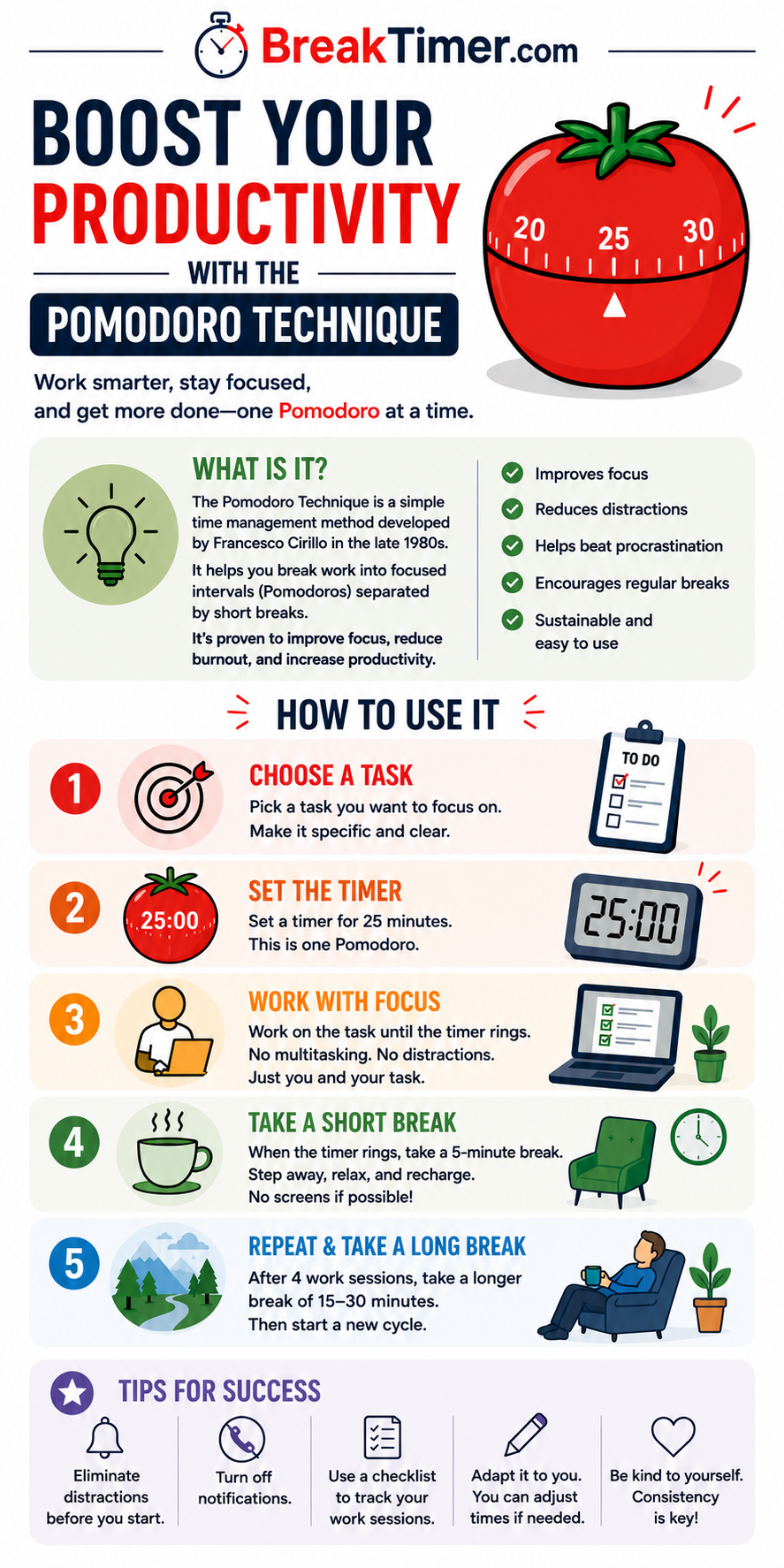
That is exactly why an Italian college student named Francesco Cirillo invented the Pomodoro Technique in the late 1980s. He was struggling to focus on his studies, so he challenged himself to focus absolutely uninterrupted for just 10 minutes. To keep time, he grabbed a kitchen timer shaped like a tomato, pomodoro in Italian, and a legendary productivity method was born.
The beauty of this system is its absolute simplicity. It stops you from trying to manage your time and instead helps you manage your energy and focus.
How It Works (The 5-Step Process)
The core structure of the technique relies on short bursts of focused work followed by immediate, guilt-free rewards: breaks. Here is the exact rhythm:
1. Pick a single task: Choose one thing you need to get done. It could be writing an email, coding a feature, cleaning a room, or studying for an exam. Turn off your phone notifications.
2. Set a timer for 25 minutes: This 25-minute block is called a Pomodoro. Put your head down and work on that single task until the timer rings. No checking texts, no opening new browser tabs, no exceptions.
3. Take a 5-minute break: When the timer goes off, step away immediately. Step away from your workspace. Stretch, grab a glass of water, or just close your eyes. This trains your brain to expect a reward after focusing.
4. Repeat the cycle: Sit back down and do another 25 minutes of work, followed by another 5-minute break.
5. Take a longer break: Once you have completed four Pomodoros, about two hours of total time, reward yourself with a longer 15 to 30-minute break. Use this time to go for a short walk, eat lunch, or fully disconnect.
Why This Simple Trick Actually Tricks Your Brain
It sounds almost too simple to work, but there is some fascinating psychology behind why it keeps people so focused:
It tames the procrastination monster: Starting a massive project feels overwhelming. But anyone can commit to working for just 25 minutes. It lowers the barrier to entry so you can just get moving.
It creates a sense of urgency: When you have an open-ended afternoon, you tend to drift. When a timer is ticking down on your desk, your brain naturally gets a little spark of focus to beat the clock.
It prevents burnout: If you force yourself to work for four hours straight, your energy crashes and your afternoon is wasted. By forcing yourself to rest before you get tired, you keep your battery charged all day.
The Only Two Rules You Must Follow
To make this work, you have to protect the integrity of the timer.
A Pomodoro is indivisible. If you get interrupted 10 minutes in by a coworker or a phone call, the Pomodoro does not count. You either have to pause the timer, address the emergency, and restart from zero, or politely tell the person, "Let me get back to you in 15 minutes."
The break is mandatory. Even if you are in the zone when the timer rings, stand up anyway. If you skip the break, you break the psychological contract you made with your brain, and you will burn out later in the day.
If you have a hard time staying on track, stop staring at your massive to-do list. Just pick one thing, set a timer for 25 minutes, and let the tomato do the heavy lifting.